

- Villa Caormina
- 10 June 2025
- 14h13
- 0 comments
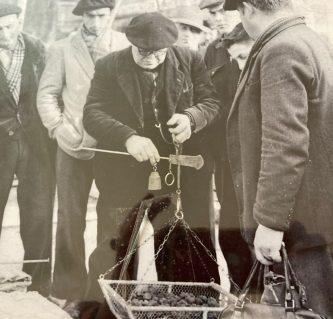
tuber mélanosporum from Quercy
The truffle, the tuber mélanosporum du Quercy, the black truffle, is born and grows in the shallows, between the roots of oak trees, among the limestone stones and the protective, nourishing earth where it is in symbiosis with the tree. This secret, chtonian vocation doesn't stop there: its scent betrays it and reveals it to the sniffing of pigs and dogs. When they dig it out of its entrails, it comes out all covered in earth, with lumps of clay or humus sticking to its grey skin. In the old days, the well-meaning farmer would skilfully add a few grams of earth to make up for the weight.
This hypogean mushroom, rustic and crusty, bumpy and black, wasn't very attractive in itself. How were we going to make it irresistible? It had to be looked after, groomed to perfection and selected. A soft brush and water to strip it, then a light canif stroke to check its inner blackness and stringy white veins and a squeeze to test its firmness, hard but not too hard: the work of an experienced craftsman, a virtuoso touch and a trained eye, with the added pleasure of transforming this charcoal walnut into a black diamond. Special treatment for this gastronomic jewel, which was to light up the most prestigious and demanding tables.
My grandfather, Adolphe Besse, had learnt the trade at Henras in Cahors, a firm founded in 1820 that still exists today, and he passed on his know-how to his son, Georges. Both were brokers at the markets in Sauzet, Lalbenque and Cahors.
Production at the time, during the war and post-war years, was at an all-time high, and it was not unusual to see two tonnes of truffles from the Causses spread out on the tables of the Théron workshop when two markets were taking place on the same day. So there was a big dilemma: how to care for, pamper and treat two tonnes of truffles in the same way as two kilos? And these jewels had to be graded and dispatched quickly, so that they were intact when they arrived at the best restaurants.
Around 1944-45, my grandfather and father came up with the idea of developing and having manufactured by an ironmonger from Prayssac, Monsieur Prunet, a machine for cleaning large quantities of truffles. They invented the "truffle brushing machine": an iron cylinder lined with soft (and above all non-aggressive) bristles. The cylinder, which was quite large, was regulated electrically to rotate slowly, and it received low-flow jets of water through holes to wash the truffles. The earthy water was gradually drained away. The lid of the cylinder was then lifted to remove the truffles. Wooden bars made in Parnac, to which the brush bristles were attached, could be easily removed for cleaning or replaced after long use.
The truffles came out of the drum soft, fresh and dapper, never damaged. And the rest of their destiny had the scent of supreme recognition: they were marvellous.
Geneviève Besse-Houdent, with additional information from Alice Besse.
Contact
Villa Caormina
Miscellaneous
Partners


